
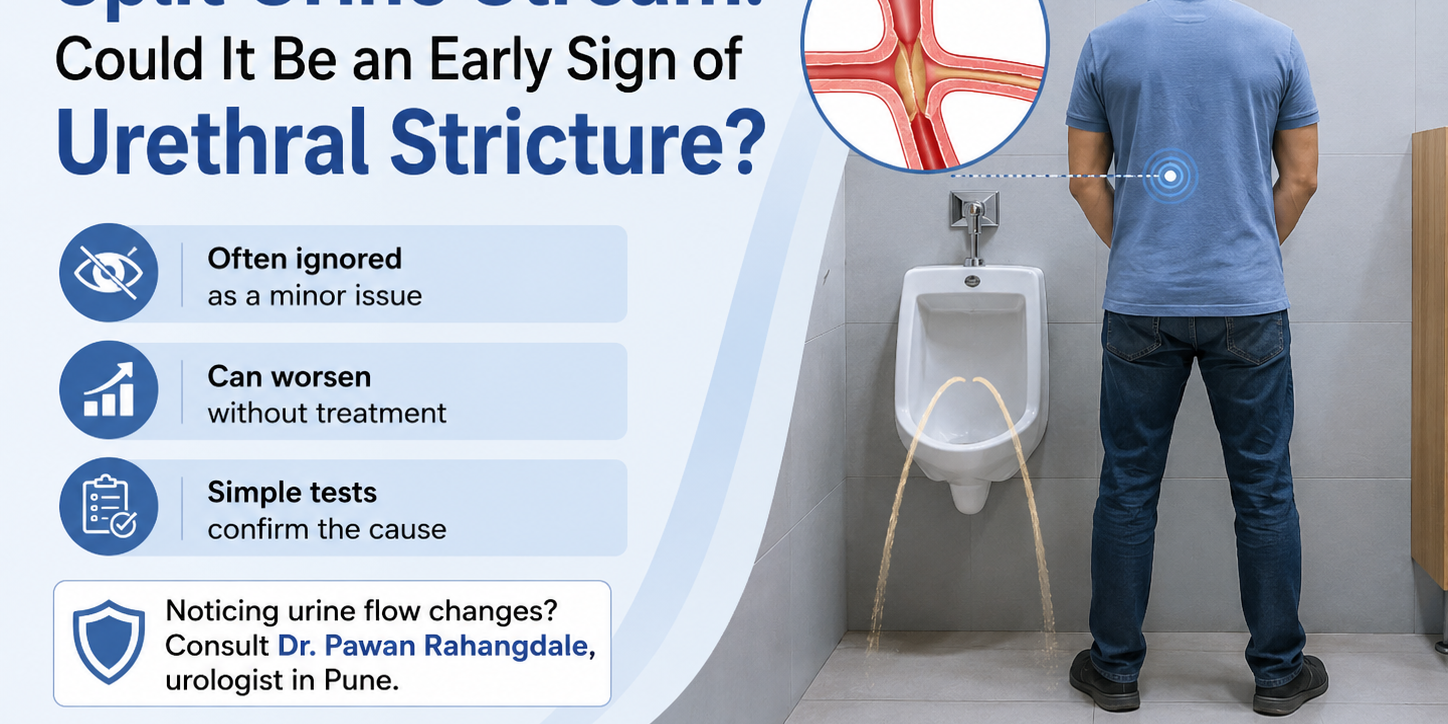
Most people don’t think twice about how their urine stream looks, until one day it doesn’t behave the way it used to. Maybe it sprays in two directions, or forces you to aim carefully to avoid a mess. It’s easy to brush this off as a one-time thing, but a split or forked urine stream is often the body’s early way of signalling a narrowing somewhere along the urethra, a condition known as urethral stricture.
This symptom is more common than most men realise, and it tends to get dismissed until it starts affecting daily comfort or bathroom habits. Understanding why it happens, and when it’s time to see a specialist, can save you from more complicated problems down the line.
Why Does the Urine Stream Split in the First Place?
To understand a split stream, it helps to understand what a healthy one looks like. Normally, urine flows out of the body through the urethra in a single, steady stream. When there’s a narrowing anywhere along this tube, whether from scar tissue, inflammation, or an injury, the pressure needed to push urine through changes the way it flows. Instead of exiting smoothly, it becomes turbulent, causing the stream to fan out, spray, or split into two.
According to the Merck Manual, one of the recognised professional references in urology, strictures can cause a double urine stream along with other obstructive symptoms such as a weak stream, hesitancy while starting to urinate, and a feeling of incomplete bladder emptying. Importantly, the manual notes that symptoms often don’t show up until the narrowing has already reduced the urethral opening significantly, which is exactly why a split stream shouldn’t be ignored even if it seems minor at first.
A few common reasons the stream may divide include:
- Scar tissue buildup, usually from a past injury, infection, or medical procedure involving the urethra
- Chronic inflammation, which can gradually narrow the urethral passage over months or years
- Adhesions near the urethral opening, which are usually minor and temporary, unlike a true stricture
What Actually Causes Urethral Stricture?
Urethral stricture doesn’t appear overnight in most cases. It tends to build up gradually, often as a result of past trauma or infection that the person may not even remember clearly. According to Wikipedia’s medically referenced overview, common causes include injury, prior urethral instrumentation such as catheter use, infection, non-infectious inflammatory conditions of the urethra, and complications following certain surgical procedures.
Some of the most frequent contributing factors seen in clinical practice include:
- A straddle injury, where a fall onto a hard surface compresses the urethra against the pelvic bone
- Untreated sexually transmitted infections, particularly gonorrhoea, which can cause inflammation that later develops into scar tissue
- Repeated or prolonged catheter use, common after surgeries or hospital stays
- Previous urethral or prostate surgery that leaves behind scar tissue as it heals
Because these causes can take months or years to fully show symptoms, many men don’t connect a split stream today with an injury or infection from years ago. That’s part of why proper diagnosis matters more than guesswork.
When a Split Stream Signals Something More
A split urine stream on its own isn’t always urethral stricture. Sometimes it’s caused by something as harmless as dried ejaculate temporarily sticking the urethral opening together, which usually resolves within a day. However, if the splitting is persistent or comes along with other symptoms, it’s worth getting checked rather than waiting it out.
Watch for these accompanying signs:
- A noticeably weaker or slower stream than before
- Straining or pushing to urinate
- A feeling that the bladder hasn’t fully emptied
- Frequent urinary tract infections or a burning sensation while urinating
- Dribbling after you think you’re done
If any of these persist alongside a split stream, it’s a strong enough reason to consult a urologist rather than assuming it will resolve on its own.
Diagnosis and Why Early Action Matters
Diagnosing a urethral stricture typically involves a physical examination, a review of symptoms and medical history, and sometimes imaging tests such as a retrograde urethrogram or a cystoscopy to see exactly where and how narrow the stricture is. Catching it early generally means simpler treatment options and a much smoother recovery.
Left unaddressed, a stricture can worsen over time, leading to complete urinary blockage in severe cases, which is considered a medical emergency. It can also raise the risk of repeated urinary tract infections, bladder strain, and in rare situations, kidney complications from urine backing up in the system.
How Urovision Urology Care Clinic Can Help
If you’ve noticed a split or spraying urine stream that isn’t going away, it’s worth getting a proper evaluation rather than living with the inconvenience. At Urovision Urology Care Clinic, patients receive a thorough diagnostic workup to pinpoint the exact cause, followed by a treatment plan suited to the severity and location of the narrowing.
The clinic offers modern, minimally invasive options for stricture urethra treatment in Pune, ranging from urethral dilation and internal urethrotomy for shorter strictures to more advanced reconstructive procedures for complex or recurrent cases. Led by Dr. Pawan Rahangdale, the team focuses on precise diagnosis and long-term relief rather than temporary fixes, so patients don’t find themselves back at square one after a few months.
Whether this is your first time noticing the symptom or you’ve been dealing with it quietly for a while, getting the right stricture urethra treatment early makes a real difference in both comfort and long-term urinary health. Don’t let an embarrassing or inconvenient symptom go unchecked when a simple consultation can clarify what’s really going on.
Frequently Asked Questions
- Is a split urine stream always a sign of urethral stricture?
Not always. A split or spraying stream can sometimes be caused by temporary adhesion at the urethral opening, which clears up on its own within a day. However, if it persists or comes with symptoms like a weak stream, straining, or repeated urinary tract infections, it’s often linked to urethral stricture and should be evaluated by a urologist. - What treatment options are available for urethral stricture?
Treatment depends on the length and severity of the stricture. Options range from urethral dilation and internal urethrotomy for shorter strictures to urethroplasty, a reconstructive surgery, for longer or recurrent cases. A urologist offering stricture urethra treatment in Pune can assess your specific case through imaging and recommend the most effective option. - Can urethral stricture come back after treatment?
Yes, recurrence is possible, especially with minimally invasive procedures like dilation if the underlying scar tissue isn’t fully addressed. This is why follow-up care and, in some cases, more definitive procedures like urethroplasty are recommended for long-term results. Regular check-ups after treatment help catch any recurrence early.
#UrethralStricture #UrologyCare #MensHealth #SplitUrineStream #PuneHealthcare #UrologyClinic #UrovisionUrologyCareClinic #DrPawanRahangdale #UrinaryHealth #PreventiveHealthcare