
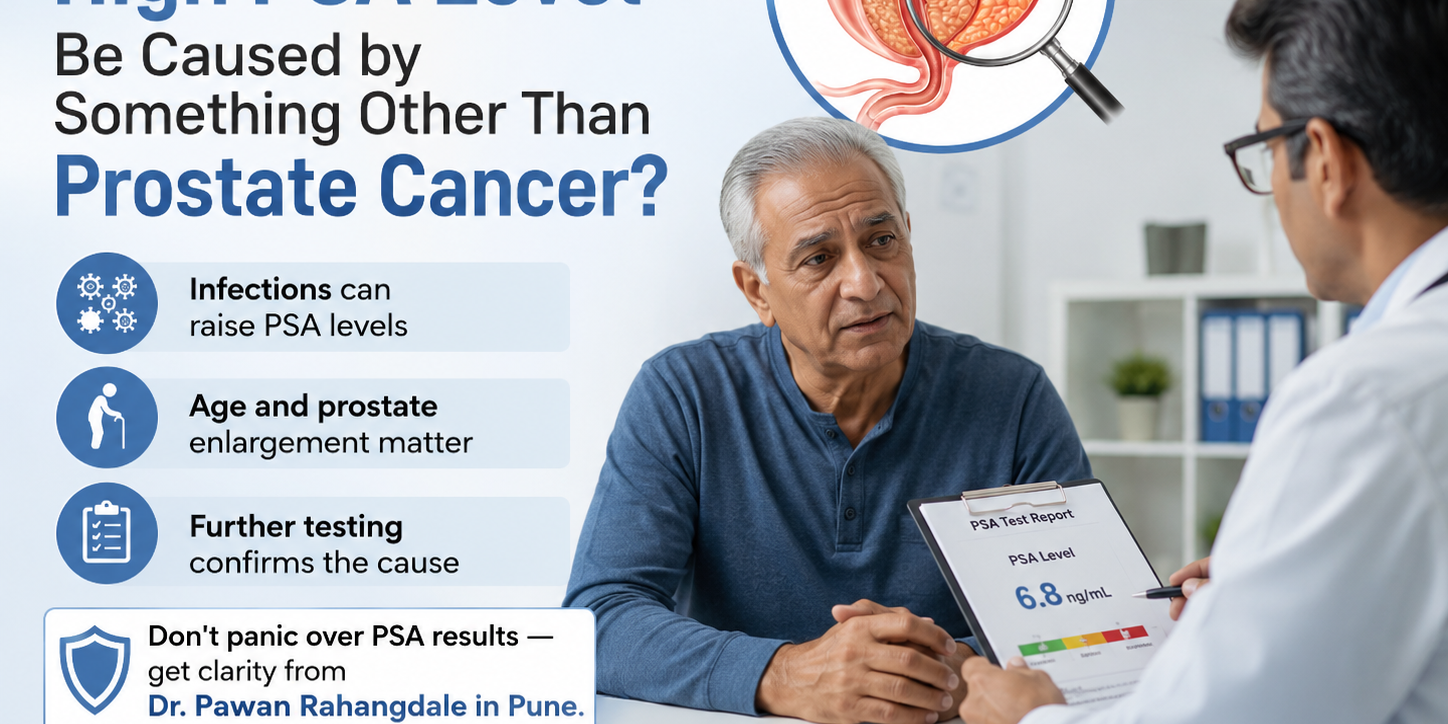
Few things make a man’s stomach drop faster than hearing the words “your PSA is elevated.” The mind jumps straight to the worst-case scenario, and understandably so, since most of us associate this test almost exclusively with cancer screening. But here is something that rarely gets said clearly enough during a routine check-up: a high PSA reading is far more often a sign of something else entirely.
If you have recently gotten this result and are sitting with that uneasy feeling, take a breath. Let us walk through what PSA actually measures, why it can rise for reasons that have nothing to do with cancer, and when it genuinely makes sense to consult a prostate cancer specialist for a closer look.
What Is PSA, and Why Does It Rise?
PSA stands for prostate-specific antigen, a protein produced by both normal and cancerous cells in the prostate gland. A PSA blood test measures how much of this protein is circulating at that moment, and it has long been used as an early screening tool for prostate cancer.
Here is the part that surprises most people. PSA is not a cancer-specific marker. It rises whenever there is more activity, irritation, or growth happening in or around the prostate, regardless of the cause. Research on the topic shows that PSA is a highly sensitive but significantly nonspecific screening tool, meaning both benign and malignant conditions can push the numbers up.
In fact, one urologist noted in a published patient health resource that up to 75 percent of the time, an elevated PSA reading arises from reasons other than cancer altogether. That is a significant number, and it is exactly why doctors never diagnose prostate cancer from a single PSA value alone.
Common Non-Cancerous Reasons Behind a High PSA
So if it is not always cancer, what else could be driving the number up? Several everyday, treatable conditions are known to elevate PSA levels temporarily or chronically.
- Benign Prostatic Hyperplasia (BPH): This is simply an age-related enlargement of the prostate, and it is extremely common. Medical research notes that more than 90 percent of men over 80 experience some degree of prostate enlargement, and a larger gland naturally produces more PSA.
- Prostatitis: Inflammation or infection of the prostate gland allows PSA to leak more easily into the bloodstream. Prostatitis can be acute or chronic and typically resolves with appropriate treatment, bringing PSA levels back down along with it.
- Urinary Tract Infections (UTIs): A UTI affecting the bladder or prostate can trigger inflammation nearby, and UTIs are considered one of the most common noncancerous causes of an elevated PSA.
- Recent ejaculation: This can cause a real but temporary spike, which is why many clinics recommend avoiding sexual activity for 24 to 48 hours before a scheduled PSA test.
- Recent procedures: A digital rectal exam, prostate biopsy, catheter placement, or cystoscopy can all cause short-term PSA elevation simply due to physical manipulation of the gland.
- Age: PSA levels naturally climb as men get older, even without any underlying disease, since normal reference ranges are adjusted by age group.
- Injury or trauma: A groin injury or fall can occasionally cause a temporary rise in PSA levels.
None of these conditions are minor to ignore, since prostatitis and UTIs need proper treatment on their own. But they are a world apart from a cancer diagnosis, and most resolve completely with the right care.
How a Prostate Cancer Specialist in Pune Tells the Difference
Given how many non-cancerous factors can influence this single number, no responsible doctor makes a cancer diagnosis from one PSA test in isolation. Instead, a proper evaluation usually looks like this:
- Repeat testing. If your first PSA comes back high, your doctor will often order a follow-up test after a few weeks, since temporary causes typically normalise on their own.
- Reviewing your history. Recent infections, procedures, medications, or sexual activity in the days before the test are all taken into account.
- Digital rectal examination (DRE). This helps assess the size, shape, and texture of the prostate directly.
- Additional blood markers. Tests like free PSA percentage or PSA density can help refine risk without jumping straight to invasive procedures.
- Imaging or biopsy, only if warranted. These are reserved for cases where the overall clinical picture still points toward malignancy after ruling out simpler explanations.
This layered approach is exactly why working with an experienced prostate cancer specialist matters. Numbers on a lab report rarely tell the whole story on their own, and context makes all the difference.
When Should You Actually Be Concerned?
While most elevated PSA results turn out to be benign, certain patterns do warrant closer attention:
- A PSA level that keeps climbing steadily across repeat tests rather than settling down.
- A very high initial reading, particularly above 10 ng/mL, which is more strongly associated with cancer.
- An abnormal finding on a digital rectal exam alongside the elevated PSA.
- A strong family history of prostate cancer combined with rising PSA trends.
If any of these apply to you, do not wait it out. Booking an appointment with a prostate cancer specialist in Pune for a thorough evaluation is a far better path than spending weeks anxiously guessing.
How Urovision Urology Care Clinic Can Help
An elevated PSA result can feel alarming, but it is rarely the full picture on its own. At Urovision Urology Care Clinic, we take the time to look beyond a single number, considering your symptoms, history, and overall risk factors before drawing any conclusions.
As a trusted prostate cancer specialist in Pune, Dr. Pawan Rahangdale and the team at Urovision Urology Care Clinic offer accurate PSA interpretation, timely repeat testing, and clear, judgment-free guidance on what your results actually mean. Whether your elevated reading turns out to be a treatable infection, BPH, or something that genuinely needs further investigation, our goal is to get you clarity quickly and manage whatever comes next with care.
If you have recently received a high PSA result, do not sit with the worry alone. Come in, get the full picture, and let an experienced specialist guide your next step.
Frequently Asked Questions
- Does a high PSA always mean prostate cancer?
No, a high PSA level does not automatically indicate prostate cancer. Common non-cancerous causes include BPH, prostatitis, urinary tract infections, recent ejaculation, and recent medical procedures. Doctors typically confirm elevated results with repeat testing and further evaluation before considering a cancer diagnosis. - How much can a UTI or infection raise PSA levels?
UTIs and prostate infections can cause a noticeable, though usually temporary, rise in PSA due to inflammation in and around the gland. PSA levels generally return to normal after the infection is treated with antibiotics, which is why doctors often recommend retesting once symptoms have cleared. - What should I do if my PSA test comes back high?
The first step is not to panic, since many causes of high PSA are treatable and unrelated to cancer. Consult a prostate cancer specialist in Pune, who may recommend a repeat test, a digital rectal exam, and a review of your recent activity or health history before deciding if further investigation is needed.
#ProstateHealth #ProstateCancerAwareness #MensHealthMatters #PSATest #UrologyCare #ProstateCancerSpecialistInPune #HealthAwarenessIndia #UrovisionCare