
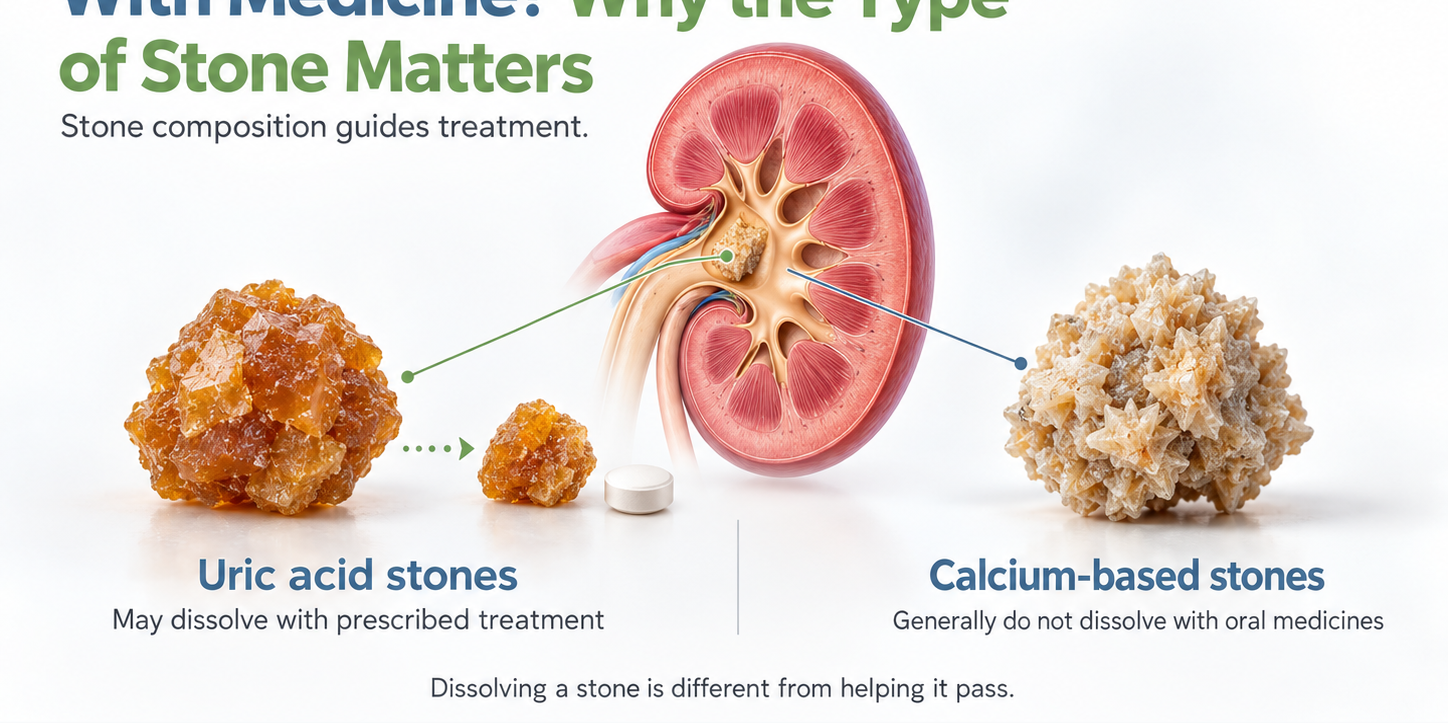
Yes, certain kidney stones can be dissolved with medicines, but not all types respond to this treatment. Uric acid stones are the main type that may dissolve through prescribed medicines that make urine less acidic. However, common calcium-based kidney stones generally cannot be dissolved using tablets, syrups or home remedies.
The right treatment depends on what the stone is made of, its size, location and whether it is blocking urine flow. Some stones may pass naturally, while others need a procedure to break them into smaller pieces or remove them.
Understanding the difference between dissolving a stone and helping it pass can prevent unnecessary treatment and delays in medical care.
Can Kidney Stones Really Dissolve Without Surgery?
Kidney stones form when certain minerals and substances in urine become concentrated and crystallise. Over time, these crystals can combine to form hard deposits.
Although kidney stones may look similar on imaging, their chemical composition can be very different.
This difference matters because medicines that work for one type may have little effect on another.
For example, some uric acid stones can gradually dissolve when urine chemistry is changed under medical supervision. In contrast, calcium oxalate stones do not dissolve through routine oral medicines.
According to the European Association of Urology (EAU) Guidelines on Urolithiasis, selected uric acid stones can be treated with oral chemolysis, a method that uses medicines to dissolve stones.
However, dissolving treatment is not suitable for everyone. A stone causing serious obstruction, infection or other complications may require more immediate intervention.
Which Types of Kidney Stones Can Be Dissolved With Medicine?
Kidney stones are classified according to the substances from which they form.
The National Institute of Diabetes and Digestive and Kidney Diseases (NIDDK) identifies four major kidney stone categories.
1. Uric Acid Stones
Uric acid stones commonly develop when urine remains excessively acidic.
Unlike most calcium stones, these stones may respond to medicines that increase urine pH, making the urine less acidic.
This process improves the ability of uric acid to remain dissolved in urine and may gradually reduce the existing stone.
However, not all stones containing urate behave in the same way. The EAU guidelines distinguish uric acid stones from sodium and ammonium urate stones when recommending oral dissolution treatment.
2. Calcium Oxalate and Calcium Phosphate Stones
Calcium stones are the most common kidney stones.
They usually contain calcium oxalate or calcium phosphate.
Existing calcium-based stones generally cannot be dissolved using standard oral medicines.
Medicines may still be prescribed to reduce the formation of new stones, depending on the patient’s urine chemistry and medical history.
If an existing calcium stone does not pass naturally, a stone-removal procedure may be necessary.
3. Struvite Stones
Struvite stones are associated with certain urinary tract infections.
These stones may grow quickly and sometimes become large enough to occupy significant portions of the kidney’s collecting system.
Antibiotics may be necessary to treat the infection, but they do not reliably dissolve an established struvite stone.
Complete stone removal is often important because remaining stone material can contribute to recurrent infection or further stone growth.
4. Cystine Stones
Cystine stones develop because of a rare inherited condition called cystinuria.
Treatment may involve increased fluid intake, medicines that raise urine pH and specialised medicines that reduce cystine crystal formation.
These treatments improve cystine solubility and can help manage the condition. However, existing cystine stones can be difficult to dissolve completely, and some require procedural removal.
The EAU guidance on metabolic evaluation and recurrence prevention provides specific treatment recommendations for cystine stones.
How Do Medicines Dissolve Uric Acid Kidney Stones?
The process of dissolving a uric acid stone is called oral chemolysis.
A urologist may prescribe an alkalising medicine such as potassium citrate or, in selected circumstances, sodium bicarbonate.
These medicines increase urine pH.
When urine becomes less acidic, uric acid becomes more soluble, allowing some existing stones to gradually dissolve.
However, urine pH must remain within an appropriate treatment range.
Excessively increasing urine pH may encourage calcium phosphate stone formation. Some medicines may also be unsuitable for people with impaired kidney function or certain electrolyte problems.
For this reason, patients may need regular urine pH monitoring, blood tests and follow-up imaging.
Do not start potassium citrate, baking soda or other alkalising products independently to dissolve a kidney stone.
The medicine, dose and monitoring plan should be determined by a qualified healthcare professional.
How Does a Doctor Identify the Type of Kidney Stone?
Knowing the type of kidney stone is essential before considering dissolution treatment.
A urologist may recommend several investigations depending on your symptoms and previous reports.
- Stone analysis: If you have passed a stone or undergone stone removal, laboratory analysis can identify its composition.
- Urine tests: Urine pH, blood cells, infection markers and other findings may provide clues about the stone type.
- Imaging tests: Ultrasound or a non-contrast CT scan can identify stones and help assess their size, location and possible composition.
A CT scan can also measure stone density, which may help distinguish certain stone types.
However, imaging characteristics alone do not always establish the exact chemical composition.
In people with repeated kidney stones, a 24-hour urine collection may be recommended to identify factors that increase the risk of recurrence.
According to the EAU guidelines, stone analysis is recommended for first-time stone formers when a suitable sample is available.
How Long Does It Take for a Kidney Stone to Dissolve?
There is no fixed timeline for dissolving a kidney stone.
When uric acid dissolution treatment is appropriate, changes may occur over several weeks or months.
The duration depends on the stone’s size, composition, urine pH, treatment response and whether urinary obstruction is present.
Larger stones may require more time, and some stones do not dissolve completely despite treatment.
A doctor may recommend follow-up imaging to assess whether the stone is becoming smaller.
If the stone remains unchanged, continues growing or causes complications, another treatment approach may be necessary.
Symptom improvement alone does not confirm that a kidney stone has dissolved or passed.
Do Kidney Stone Medicines Dissolve Stones or Help Them Pass?
This is an important distinction because not all medicines used for kidney stones have the same purpose.
Some medicines are prescribed to manage pain, while others help certain stones pass through the urinary tract.
For example, an alpha-blocker such as tamsulosin may be considered for selected stones in the lower part of the ureter, the tube connecting the kidney to the bladder.
The medicine relaxes smooth muscle in the urinary tract, which may help the stone pass.
However, tamsulosin does not chemically dissolve the stone.
The 2026 EAU urolithiasis guidance supports considering alpha-blockers for selected distal ureteral stones, particularly those measuring approximately 5 to 10 mm.
This treatment is not appropriate for every patient. Stone location, pain, kidney function and the presence of infection must be considered.
Can Drinking Lemon Water or Herbal Remedies Dissolve Kidney Stones?
Drinking enough water helps dilute urine and may reduce the risk of forming additional stones.
Lemons contain citrate, a substance that can help prevent certain crystals from developing into stones.
However, drinking lemon water does not reliably dissolve an existing calcium oxalate stone.
Similarly, herbal drinks and products marketed as kidney stone dissolvers should not be assumed to work simply because they are described as natural.
There is insufficient reliable clinical evidence that commonly promoted home remedies can consistently dissolve established kidney stones.
Delaying appropriate treatment while relying on such remedies may be harmful when a stone is causing obstruction or infection.
The NIDDK dietary guidance explains that hydration and dietary changes can help prevent kidney stones, but recommendations vary according to stone composition.
When Is Surgery or a Stone Removal Procedure Necessary?
Not every kidney stone requires surgery.
Some small stones can pass naturally with appropriate pain management, observation and follow-up.
However, a urologist may recommend active treatment when a stone is unlikely to pass, causes persistent pain, blocks urine flow, grows larger or contributes to repeated infections.
Depending on the stone’s characteristics, procedures may include shock wave lithotripsy, ureteroscopy with laser stone fragmentation or percutaneous nephrolithotomy (PCNL).
These procedures break stones into smaller pieces or remove them rather than dissolving them through oral medicines.
According to the NIDDK’s kidney stone treatment guidance, treatment selection depends on stone size, location and composition.
Seek emergency medical care if kidney stone symptoms occur with fever, chills, inability to urinate, severe uncontrolled pain or persistent vomiting. An infected, obstructed kidney can require urgent drainage rather than medicine alone.
Frequently Asked Questions
1. Can a 5 mm Kidney Stone Dissolve With Medicine?
It depends on the stone type. A 5 mm uric acid stone may respond to medically supervised dissolution treatment. However, a calcium-based stone of the same size generally cannot be dissolved using oral medicines. Some 5 mm stones may pass naturally, depending on their location and other clinical factors.
2. Does Potassium Citrate Dissolve Every Type of Kidney Stone?
No. Potassium citrate can help dissolve selected uric acid stones by making urine less acidic. It may also help prevent certain calcium or cystine stones, but it does not reliably dissolve established calcium oxalate stones. Treatment requires medical supervision.
3. Can Kidney Stones Disappear Without Treatment?
Some small stones pass naturally through urine without a procedure. A few may remain inside the kidney without causing symptoms. However, a stone disappearing from follow-up imaging does not necessarily mean it dissolved. It may have passed, and follow-up assessment can help confirm what happened.
Conclusion
Some kidney stones can be dissolved with medicine, but the treatment works mainly for selected uric acid stones. Calcium oxalate, calcium phosphate and other stone types often require different approaches.
Before starting treatment, it is essential to understand the stone’s composition, size, location and possible effect on kidney function.
If you have been diagnosed with kidney stones and want to know whether medicines may help, consult Dr. Pawan Rahangdale at Urovision Urology Care Clinic for an individual assessment and guidance on appropriate treatment options.
For personalised guidance on kidney stone treatment in pune, discuss your scan findings and available medical or procedural treatments with a qualified urologist.