
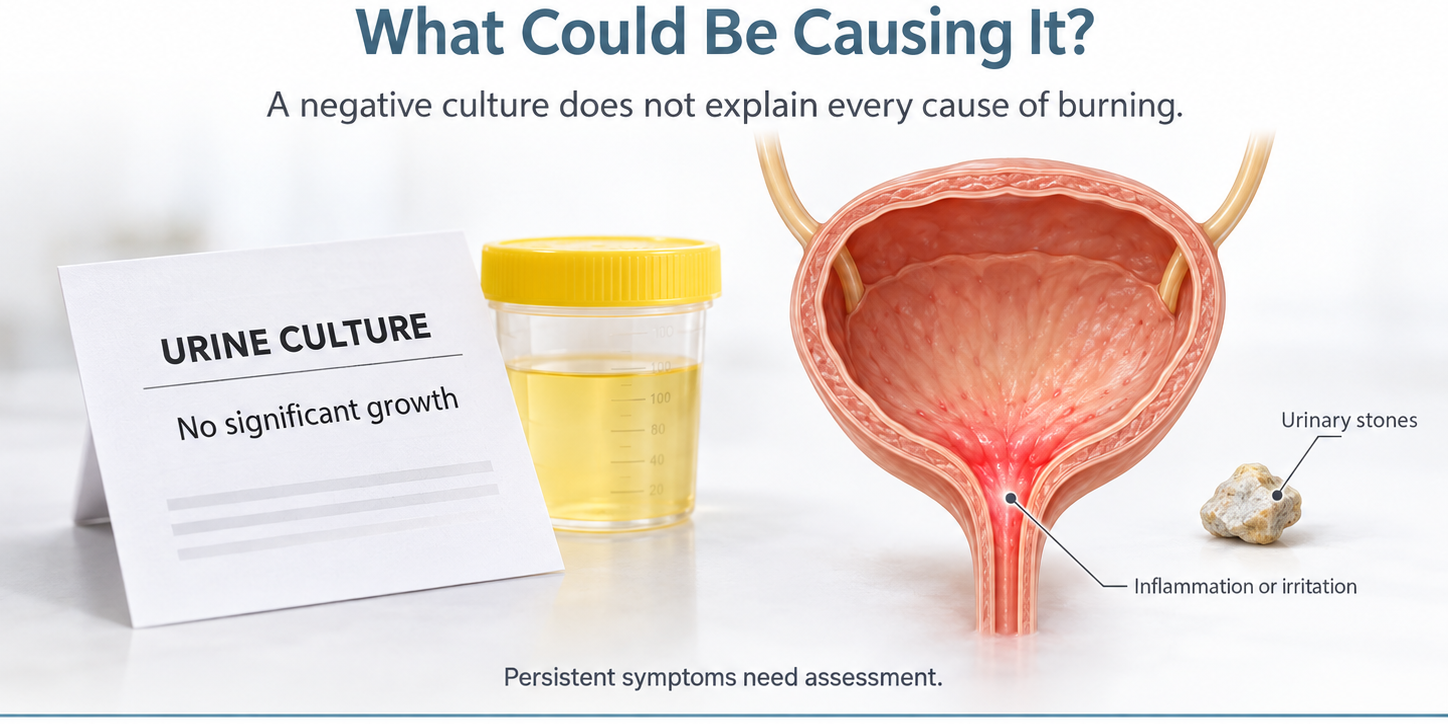
Yes, you can experience burning while urinating even when your urine culture report is negative. A negative culture generally means that the laboratory did not detect significant growth of the bacteria it routinely tests for. However, it does not rule out every infection or other condition affecting the urinary tract.
Burning urination, medically called dysuria, can result from urethral inflammation, kidney stones, prostate problems, bladder pain syndrome or irritation around the genital area. Sometimes, an infection may also be missed because of recent antibiotic use or other testing factors.
If the burning continues despite a negative report, identifying the actual cause is more useful than repeatedly taking antibiotics without a confirmed diagnosis.
What Does a Negative Urine Culture Actually Mean?
A urine culture checks whether bacteria grow from a urine sample under laboratory conditions. It is commonly used to investigate urinary tract infections (UTIs) and identify bacteria that may require antibiotic treatment.
When a report says “no growth,” it usually means that no significant bacterial growth was detected under the laboratory’s testing conditions.
However, a urine culture does not identify every possible cause of urinary discomfort.
For example, a routine bacterial culture does not reliably detect certain sexually transmitted infections. It also cannot diagnose non-infectious conditions such as kidney stones or bladder pain syndrome.
A negative result therefore needs to be interpreted alongside your symptoms, urine routine examination, medical history and physical findings.
According to the National Institute of Diabetes and Digestive and Kidney Diseases (NIDDK), urine culture is useful for identifying common bacterial infections, but additional evaluation may be necessary when symptoms suggest another condition.
Why Does It Burn When You Urinate Even Without a UTI?
Burning urination is a symptom, not a diagnosis. Several conditions can irritate the urinary tract without producing a positive routine urine culture.
1. Urethritis or Sexually Transmitted Infections
Urethritis occurs when the urethra, the tube carrying urine outside the body, becomes inflamed.
It can cause burning while passing urine, itching or discomfort around the urethral opening, and sometimes an unusual discharge.
Certain infections, including chlamydia and gonorrhoea, may cause urethritis but are not reliably identified through a routine bacterial urine culture.
When clinically appropriate, doctors may recommend a nucleic acid amplification test (NAAT), which detects genetic material from specific infectious organisms.
The Centers for Disease Control and Prevention (CDC) recommends NAAT testing for chlamydia and gonorrhoea when evaluating suspected infectious urethritis.
Not everyone with burning urination requires STI testing. The decision depends on symptoms, sexual history and clinical findings.
2. Kidney Stones or Urinary Tract Stones
A small stone travelling through the urinary tract can irritate its lining and cause pain or burning during urination.
Other possible symptoms include lower abdominal discomfort, pain in the side or back, an increased urge to urinate and blood in the urine.
Kidney stones do not necessarily cause a bacterial infection, so the urine culture may remain negative.
According to the NIDDK guidance on kidney stone symptoms, urinary pain, blood in urine and discomfort in the back or groin can occur with stones.
An ultrasound or other imaging test may be recommended when symptoms suggest a urinary stone.
3. Prostatitis or Chronic Pelvic Pain in Men
In men, burning urination may sometimes be associated with inflammation or pain involving the prostate and surrounding pelvic structures.
Prostatitis can cause discomfort while urinating, pain in the lower abdomen or perineum, urinary frequency and sometimes painful ejaculation.
There are different types of prostatitis. Some result from bacterial infection, while others involve chronic pelvic pain without an identifiable bacterial cause.
The NIDDK’s information on prostatitis explains that chronic prostatitis or chronic pelvic pain syndrome can produce urinary symptoms even when a bacterial infection is not identified.
Treatment depends on the type of prostatitis. Repeated antibiotics are not automatically appropriate when bacterial infection has not been established.
4. Bladder Pain Syndrome
If urinary discomfort continues for several weeks and cultures remain negative, a doctor may consider interstitial cystitis, also called bladder pain syndrome.
This condition can cause bladder pressure, pelvic discomfort, frequent urination and a persistent urge to pass urine.
A common pattern is discomfort that becomes worse as the bladder fills and temporarily improves after urination.
However, burning during urination alone is not enough to diagnose this condition.
The American Urological Association’s clinical guidance describes bladder pain syndrome as a chronic condition in which symptoms persist for at least six weeks without infection or another identifiable cause.
Doctors consider this diagnosis only after evaluating other possible explanations.
5. Genital Irritation or Vaginal Conditions
Sometimes the burning sensation does not originate inside the bladder.
In women, inflammation around the vaginal opening or external genital area can cause stinging when urine touches irritated skin.
Possible causes include fungal infections, vaginal inflammation, skin conditions and hormonal changes associated with menopause.
Certain soaps, scented hygiene products and other irritants may also contribute to discomfort.
The NHS guidance on vaginitis recognises pain during urination as a possible symptom of vaginal inflammation.
When itching, unusual discharge or external soreness accompanies burning urination, a genital examination or targeted testing may be more useful than repeating urine cultures alone.
Can Antibiotics Make a Urine Culture Negative?
Yes. Taking antibiotics before providing a urine sample can reduce bacterial growth and sometimes produce a negative culture result.
This can happen even when symptoms have not completely disappeared.
A medical review on sterile pyuria describes recent antibiotic treatment as one possible explanation for white blood cells in the urine without bacterial growth on routine culture.
Sterile pyuria means that white blood cells are present in the urine, but a standard culture does not detect significant bacterial growth.
It is not a diagnosis by itself. It can occur with infection, inflammation and several other conditions.
Tell your doctor if you took antibiotics before the test, including medicines started without a prescription.
Do not stop prescribed treatment or repeat antibiotics without medical guidance.
What Tests Are Needed if Burning Urination Continues?
The appropriate investigation depends on your symptoms and previous test results.
Your doctor may review whether the original urine sample was collected correctly, whether antibiotics were taken before testing and whether another sample is necessary.
Further investigations may include:
- Urine routine and microscopy: To check for white blood cells, red blood cells or other abnormalities.
- Repeat urine culture: When a bacterial infection is still suspected or the earlier sample may not have been reliable.
- STI testing: When symptoms or sexual history suggest urethritis or another sexually transmitted infection.
- Ultrasound or other imaging: When kidney stones, urinary obstruction or incomplete bladder emptying are suspected.
- Targeted examination: To assess prostate, genital, pelvic floor or bladder-related conditions, depending on the patient’s symptoms.
A cystoscopy, which uses a small camera to examine the urethra and bladder, may be considered in selected cases of persistent symptoms or concerning findings. It is not routinely required for everyone with a negative urine culture.
An accurate diagnosis often depends more on selecting the right investigation than on performing numerous tests.
Should You Take Antibiotics if Your Urine Culture Is Negative?
Not automatically.
Antibiotics treat bacterial infections, but they do not resolve every cause of burning urination.
If discomfort results from a urinary stone, pelvic floor dysfunction, skin irritation or non-bacterial bladder pain, antibiotics may provide little or no benefit.
Unnecessary antibiotic use can cause side effects and contribute to antibiotic resistance.
However, a negative culture does not always exclude infection. In certain situations, treatment may still be appropriate based on symptoms, examination and other findings.
The NICE guidance on urinary tract infection treatment recommends reassessment when symptoms worsen or fail to improve, including consideration of alternative diagnoses.
Avoid starting antibiotics independently simply because the burning resembles a previous UTI.
When Should You See a Urologist?
Persistent burning urination deserves medical evaluation, particularly when symptoms return repeatedly despite negative cultures.
A consultation is appropriate if you experience continuing discomfort, urinary frequency, difficulty passing urine, a weak urinary stream or persistent pelvic pain.
Visible blood in urine should also be assessed even if the burning settles.
Seek urgent medical care if burning urination is accompanied by fever and chills, severe back or side pain, vomiting, inability to urinate or significant weakness.
These symptoms may indicate a serious infection, urinary obstruction or another condition requiring prompt treatment.
Pregnant women and people with significant underlying medical conditions should also seek timely evaluation when urinary symptoms develop.
Frequently Asked Questions
1. Can I Have a UTI Even if My Urine Culture Shows No Growth?
Yes, it is possible in some circumstances. Previous antibiotic use, specimen-related factors or limitations of routine testing may affect the result. However, many non-infectious conditions can cause similar symptoms, so further evaluation should be based on your clinical findings.
2. Why Do I Have White Blood Cells in Urine but No Bacteria in the Culture?
This is sometimes called sterile pyuria. It can occur after recent antibiotic treatment or with certain infections, urinary stones and inflammatory conditions. The finding requires interpretation alongside your symptoms rather than automatic antibiotic treatment.
3. Can Dehydration Cause Burning Urination With a Negative Culture?
Concentrated urine may worsen urinary discomfort in some people, particularly when the bladder or urethra is already sensitive. However, persistent burning should not be attributed to dehydration without considering other causes. If symptoms continue despite adequate hydration, medical evaluation is appropriate.
Conclusion
Burning urination with a negative urine culture does not necessarily mean that nothing is wrong. While a routine bacterial infection may be less likely, urethral inflammation, urinary stones, prostate conditions, bladder pain syndrome and genital irritation can produce similar symptoms.
Finding the actual cause helps avoid unnecessary antibiotics and supports more appropriate treatment.
If burning urination persists or repeatedly returns despite negative urine culture results, consult Dr. Pawan Rahangdale at Urovision Urology Care Clinic for an individual assessment of your urinary symptoms.
For persistent urinary discomfort and further evaluation, consult a urologist in pune to understand the possible causes and discuss suitable treatment options.