
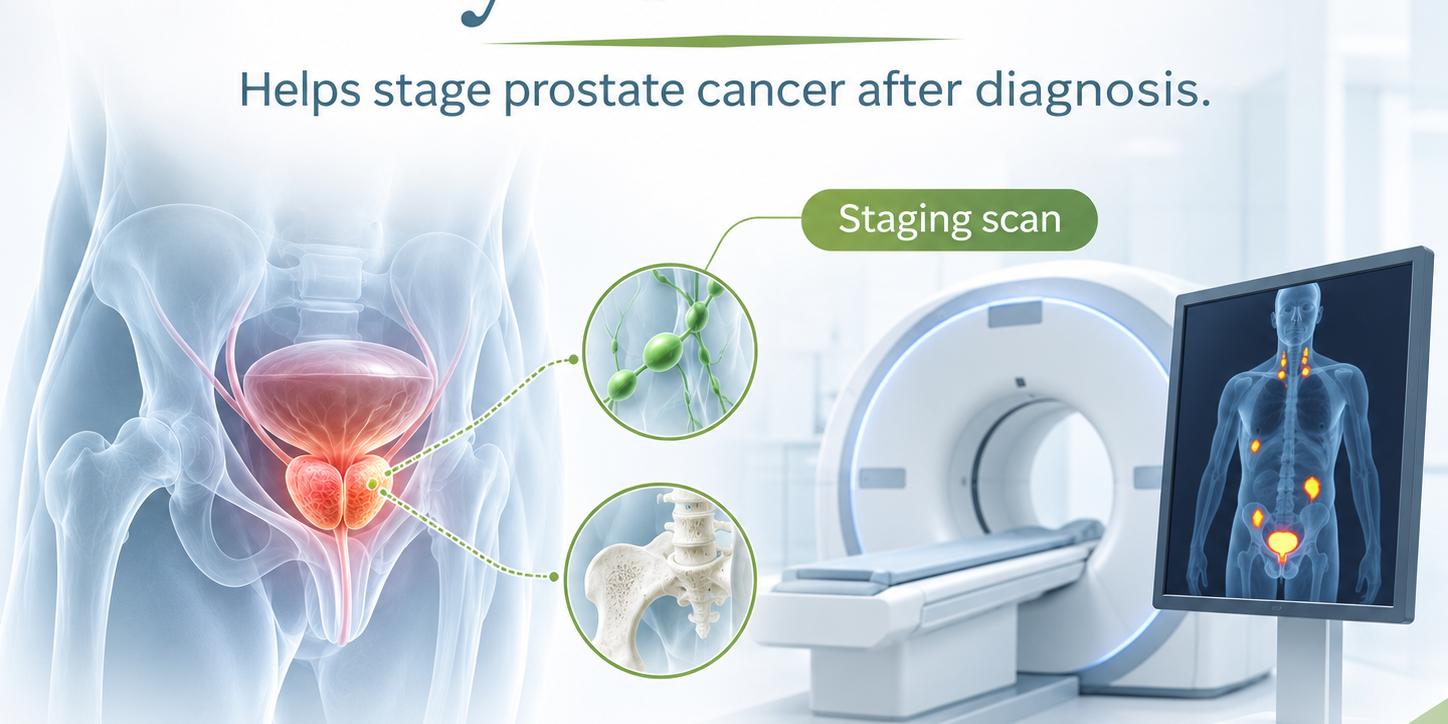
A PSMA PET scan may be recommended after a prostate-cancer diagnosis to check whether cancer has spread to lymph nodes, bones or other areas. This process, called staging, helps doctors plan treatment. Being referred for the scan does not mean that spread has already been confirmed, and not everyone with prostate cancer needs it. NCI
After receiving a diagnosis, another test can feel like another worry. Understanding the question your doctor wants the scan to answer can make the next appointment easier to approach.
What does a PSMA PET scan show?
PSMA stands for prostate-specific membrane antigen, a protein often present in large amounts on prostate cancer cells. A small amount of a radioactive substance, called a tracer, is injected into a vein. It attaches to PSMA and produces signals that the scanner can detect. Springer Nature Link
PET means positron emission tomography. It is usually combined with computed tomography, or CT, which helps show where the signals are located in the body. Together, these images help doctors look for possible cancer deposits beyond the prostate. NCI
The scan produces a map of suspicious areas. It does not, by itself, decide which treatment you should receive.
Who may need the scan after diagnosis?
The decision depends on the cancer’s risk category and whether additional staging could influence care.
Current European Association of Urology guidance recommends PSMA PET/CT, when available, for high-risk or locally advanced disease. It also supports its use for unfavourable intermediate-risk disease, although that recommendation is weaker. Routine additional staging scans are not recommended for low-risk or favourable intermediate-risk localised cancer. Uroweb
These labels describe groups with different risks; they are not interchangeable with a confirmed cancer stage. Ask your doctor to explain which group applies to you and what information supports that assessment.
If PSMA PET/CT is unavailable, a CT scan of the abdomen and pelvis together with a bone scan may be used for appropriate patients. Uroweb
PSMA PET versus MRI: why might both be needed?
A prostate MRI provides detailed pictures of the gland and nearby tissues. It helps assess the local extent of a tumour and whether it appears to extend outside the prostate. MRI uses magnetic fields and radio waves rather than ionising radiation. radiologyinfo.org
PSMA PET/CT adds a different type of information by looking for tracer uptake in suspicious sites, including lymph nodes and bones. The CT component helps locate those findings. NCI
Therefore, having already undergone an MRI does not automatically make the PET scan unnecessary. A useful question is: “What could this scan tell us that my MRI has not answered?”
How can the results affect treatment planning?
Finding previously unsuspected spread can change the proposed treatment strategy. In a randomised trial involving men with newly diagnosed high-risk disease, PSMA PET/CT detected spread more accurately than conventional CT and bone scanning and changed treatment plans more often. That trial did not establish that using the scan made patients live longer. NCI
Ask your specialist to explain the practical consequence of your own result. Does it support the original plan, suggest a different approach, or identify something that needs clarification before a decision?
You should leave the discussion understanding both what the report says and what the team proposes to do about it.
What can a clear or suspicious scan not prove?
A clear scan cannot exclude every cancer cell. Very small deposits may be below the scanner’s detection limit. A negative result therefore does not automatically remove the need for other staging decisions, including consideration of lymph-node assessment during surgery. Uroweb
Likewise, a bright area is not always cancer. Some benign bone changes, including healing fractures, can take up the tracer. Specialists compare the uptake pattern with CT or MRI appearances and previous scans. An uncertain finding may need further assessment rather than an immediate conclusion that cancer has spread. PMC
Avoid interpreting an isolated phrase or image without the complete report and your specialist’s explanation.
Preparing for the appointment
The visit includes an injection, a waiting period while the tracer circulates, and the scan itself. Allow more time than the scanning time alone. Tell the department beforehand if lying flat is difficult or you feel anxious in scanning equipment. CUH
Follow that centre’s instructions about food, water and medicines. Ask for individual advice if you have a prescribed fluid restriction. The scan involves radiation, with a small associated long-term risk that should be weighed against its expected benefit. Afterwards, follow the department’s advice about fluids and temporary close-contact precautions around young children or pregnant people. CUH
For your results appointment, prepare three questions:
- What stage do the findings suggest, and is anything uncertain?
- Will this result change my treatment plan?
- What happens next, and when should that step take place?
Frequently asked questions
Is PSMA PET only used for late-stage cancer?
No. It can be used before initial treatment in selected patients whose cancer has not been confirmed to have spread. Its purpose is to investigate that possibility when it matters for planning. Uroweb
Will I receive the result immediately?
Usually, the images need specialist interpretation first. Ask the scanning centre when the report should reach your referring doctor and arrange a discussion of the findings. Reporting times differ between services. CUH
Does “equivocal” mean the scan has confirmed spread?
No. It means a finding is uncertain. Your team may compare it with other imaging or arrange further evaluation before deciding what it means for treatment. PMC
Discuss the reason for your scan
If a PSMA PET scan has been recommended, bring your biopsy report, PSA results and previous imaging to your consultation. At Urovision Urology Care Clinic, you can consult Dr. Pawan Rahangdale, a prostate cancer specialist in pune, to discuss why staging has been advised and how its findings may guide your next step.
#prostatecancer #psmapetscan #cancerstaging #prostatehealth #urovision