
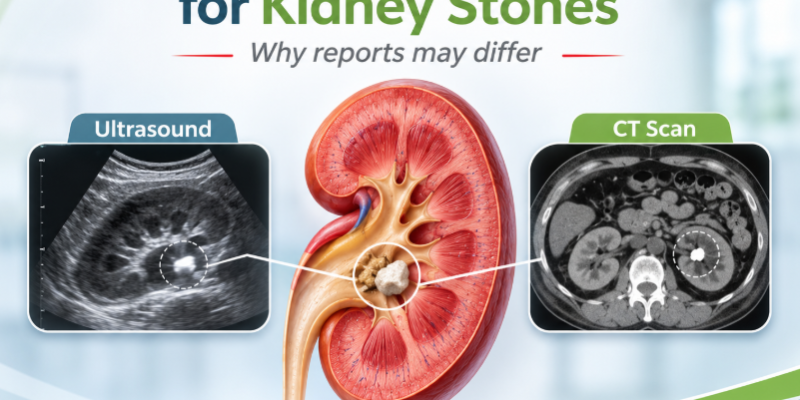
For most adults, a properly performed non-contrast CT scan is more accurate than ultrasound for finding and locating kidney stones. However, conflicting reports should be reviewed alongside your symptoms and the dates of the scans. A difference does not automatically mean the stone has grown, disappeared or needs surgery. Uroweb
Bring both reports and, if possible, the actual scan images to your urologist. Comparing the same stone in the same location is more useful than comparing two measurements without that context.
Why Can Ultrasound and CT Give Different Answers?
The tests create images in different ways. Ultrasound uses sound waves, while CT combines X-rays with computer processing to produce detailed images of the urinary tract. Ultrasound avoids ionising radiation and can show kidney stones and signs of a urinary blockage. CT can also reveal other problems that may explain symptoms. NIDDK
Differences can arise from how clearly the stone is seen, how its edges are measured and whether both tests examined the same finding.
Ultrasound Can Miss a Stone or Suggest One That CT Does Not Confirm
Ultrasound accuracy depends partly on technique, the person performing the scan and the patient’s body build. It may miss stones or suggest a stone that CT does not confirm. PMC
The Size May Be Measured Differently
Ultrasound can overestimate stone size, particularly for smaller stones. A 2025 surveillance study found detection and measurement differences between ultrasound and CT. This single-centre retrospective study cannot predict the exact error in an individual report. PMC
For example, 4 mm on CT and 6 mm on ultrasound do not, by themselves, prove growth. This illustrative comparison is not a rule for correcting measurements.
The Scans May Reflect Different Moments
A small stone may pass between appointments, sometimes without being noticed. If the scans were taken days or weeks apart, the doctor will consider whether the situation changed between them. Do not assume passage solely because a later report looks reassuring. NHS
Why Is Non-Contrast CT Often Used to Clarify the Result?
Non-contrast CT means a CT scan without injected contrast dye. It can help establish the stone’s location, overall stone burden and density. These details may matter when deciding whether observation or a procedure is appropriate. Uroweb
Imaging pathways differ between guidelines. European guidance recommends CT confirmation after initial ultrasound for acute flank pain. NICE recommends low-dose non-contrast CT as the initial urgent test for adults with suspected renal colic, the pain associated with a urinary stone. Both approaches recognise CT’s diagnostic value. Uroweb
These recommendations concern a clinical assessment of suspected stones. They do not mean every person with back pain or every difference between reports needs CT.
Does Everyone With Conflicting Reports Need Another Scan?
No. The first step is often reviewing the existing images and clarifying what remains uncertain.
Your urologist will consider your current symptoms, medical history, examination and relevant blood tests before deciding whether further imaging is useful. Mention previous kidney problems, operations and the possibility of pregnancy. NIDDK
Useful questions include:
- Are both reports describing the same kidney and the same stone?
- Was the measurement taken in a comparable way?
- Is there evidence of blockage, and does it match my symptoms?
- Would another scan change the treatment plan?
- Could the existing images be reviewed before repeating the test?
If a CT does not show a stone but pain continues, reassessment may be needed. Flank pain has other possible causes, and selected patients may need a different imaging approach. A negative stone scan should not be used to dismiss persistent symptoms. Acute Onset Flank Pain
Why Might Ultrasound Still Be the Better Choice?
Ultrasound avoids radiation, which is useful when repeated imaging is being considered. CT can use low-dose protocols, but the choice should still be based on the information needed. NIDDK
Pregnancy and childhood require particular care. NICE recommends ultrasound first for pregnant patients and children with suspected renal colic. In children, low-dose CT may be considered if uncertainty remains after ultrasound. Pregnancy-related decisions need an individual assessment rather than applying the usual adult pathway automatically. NICE
When Should You Seek Urgent Help?
Do not wait for a routine comparison of reports if you have severe pain, fever or chills with suspected kidney stones. Seek urgent medical care. NHS
New stone-type symptoms also need prompt assessment if you have only one functioning kidney. An infected, obstructed kidney or an inability to produce urine can be an emergency. Uroweb
Frequently Asked Questions
Can a Normal Ultrasound Rule Out Every Kidney Stone?
No. Ultrasound can miss stones. If symptoms or other findings still suggest a urinary stone, your clinician may recommend further assessment rather than relying on the ultrasound result alone. PMC
Does a Stone CT Always Need Contrast Dye?
No. Non-contrast CT is commonly used for suspected stones. A contrast examination may be selected when another clinical question needs answering, such as clarifying anatomy or investigating another cause of symptoms. Acute Onset Flank Pain
Should I Choose Surgery Based on the Larger Measurement?
No. Ask your urologist to resolve a meaningful measurement discrepancy before making a decision. Ultrasound size overestimation can affect treatment advice, so the largest number should not automatically determine the plan. PMC
Bring Both Scan Results to Your Consultation
For kidney stone treatment in Pune, consult Dr. Pawan Rahangdale at Urovision Urology Care Clinic. Bring both reports, the images or access links, scan dates and recent test results. The aim is to understand whether the difference changes your care and what follow-up is appropriate.
#kidneystones #ultrasound #ctscan #urologycare #urovision