
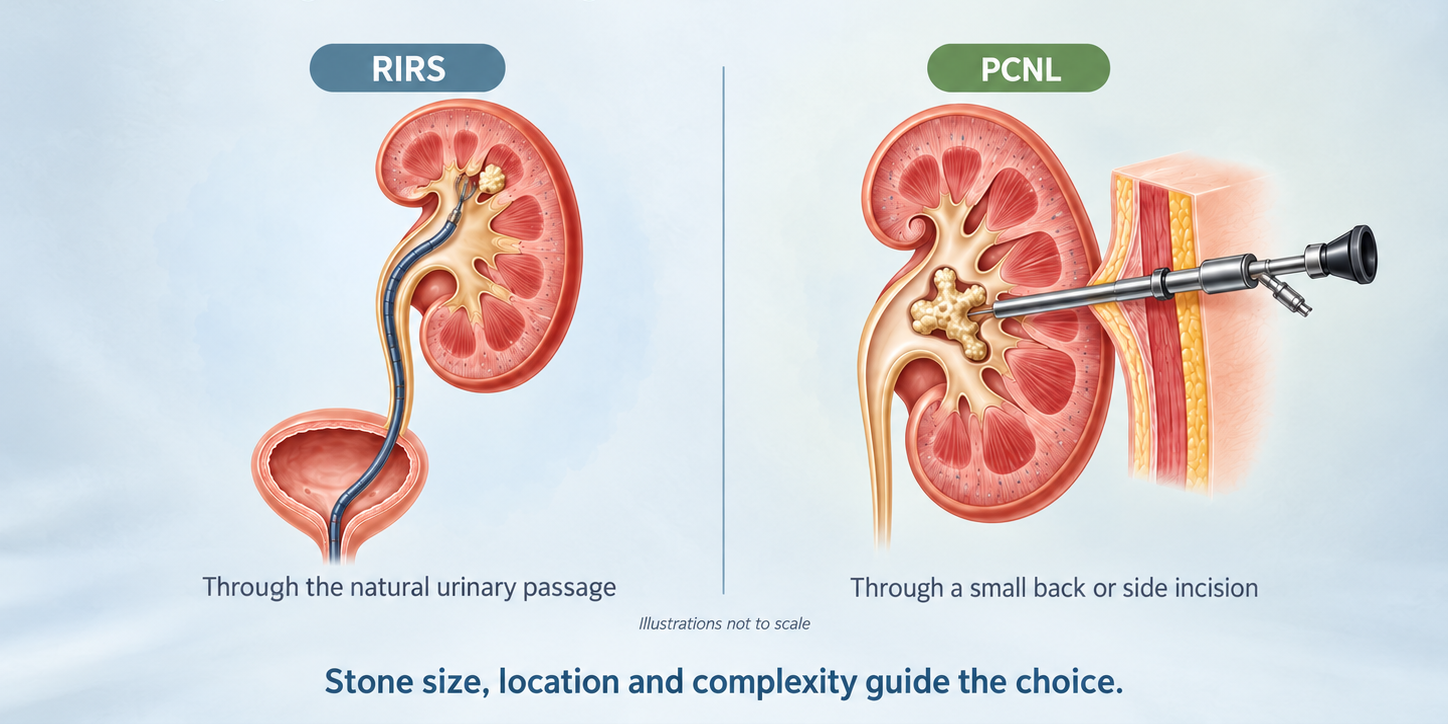
RIRS and PCNL are both minimally invasive procedures used to treat kidney stones, but the better option depends mainly on the stone’s size, location, complexity and your overall health. RIRS removes or breaks stones using a flexible instrument passed through the natural urinary passage, while PCNL reaches the kidney through a small incision in the back or side.
RIRS may be suitable for many small to medium-sized kidney stones because it does not require an external incision. PCNL is generally preferred for larger stones, particularly those measuring more than 2 cm, because it can remove a greater amount of stone material directly.
However, one procedure is not automatically better for every patient. Understanding how these treatments differ can help you discuss the recommendation with your urologist.
What Is RIRS for Kidney Stones?
Retrograde Intrarenal Surgery (RIRS) is a procedure used to treat stones inside the kidney through the natural urinary tract.
During RIRS, a urologist passes a thin, flexible instrument called a ureteroscope through the urethra, bladder and ureter until it reaches the kidney.
A small camera allows the surgeon to locate the stone. Laser energy is then used to break it into smaller fragments, which may be removed using specialised instruments or left to pass naturally when appropriate.
Because RIRS does not require a cut through the skin, it is often considered a less invasive option than procedures involving direct access through the back.
A temporary ureteral stent may be inserted to maintain urine drainage and support recovery.
However, RIRS does not guarantee complete stone removal in a single procedure, particularly when stones are large, hard or difficult to reach.
What Is PCNL for Kidney Stones?
Percutaneous Nephrolithotomy (PCNL) is a minimally invasive surgical procedure generally used for larger or more complex kidney stones.
Instead of passing instruments only through the urinary tract, the surgeon creates a small passage through the skin of the back or side directly into the kidney.
A specialised instrument called a nephroscope is passed through this opening to locate, break and remove the stone.
This approach allows the surgeon to extract larger stone fragments directly rather than depending mainly on smaller fragments passing through the urinary tract.
PCNL is particularly useful for large stones, multiple stones and branching stones known as staghorn calculi.
A smaller-access variation called mini-PCNL may be considered in selected patients.
According to the European Association of Urology (EAU) Guidelines on Urolithiasis, PCNL is recommended as the first-line treatment for most kidney stones larger than 2 cm.
RIRS vs PCNL: What Are the Main Differences?
Although both procedures aim to clear kidney stones, they differ in how the surgeon reaches the stone and what recovery may involve.
| Factor | RIRS | PCNL |
| Surgical access | Through the natural urinary passage | Through a small incision in the back or side |
| Common use | Many small and medium-sized stones | Large or complex kidney stones |
| Stone removal | Laser fragmentation, with removal or passage of fragments | Direct fragmentation and extraction |
| External incision | No | Yes |
| Recovery | Often shorter | May require longer observation and recovery |
| Repeat procedures | More likely for larger stone burdens | Often provides better clearance for large stones in one session |
These are general differences rather than fixed rules. The exact results depend on stone characteristics, the surgical technique and the patient’s health.
Why Does Kidney Stone Size Matter When Choosing RIRS or PCNL?
Stone size is one of the strongest factors influencing treatment selection.
For stones smaller than 10 mm, a urologist may consider observation, shock wave lithotripsy or RIRS, depending on symptoms and stone location.
For stones between 10 and 20 mm, RIRS is frequently considered, although mini-PCNL may offer better stone clearance in selected cases.
When stones are larger than 20 mm, PCNL is generally preferred because complete clearance with RIRS becomes more difficult and additional procedures may be necessary.
The NICE guideline on renal and ureteric stones similarly recommends PCNL for renal stones larger than 20 mm, including staghorn stones, while considering ureteroscopy if PCNL is unsuitable.
Stone size guides the decision, but it does not determine the procedure on its own.
Why Might Your Urologist Recommend PCNL for a 15 mm Stone?
A 15 mm kidney stone falls within a size range where more than one treatment may be reasonable.
Although RIRS may be suitable, PCNL or mini-PCNL might be recommended when stone characteristics make complete clearance more challenging.
For example, a stone in the lower part of the kidney may be difficult to access or remove completely using a flexible scope.
Multiple stones, unfavourable kidney anatomy or a large overall stone burden may also influence the recommendation.
Evidence reviewed in the EAU guidelines suggests that mini-PCNL can achieve higher stone-free rates than RIRS for some stones measuring 10 to 20 mm. However, it is also associated with a greater risk of bleeding and a longer hospital stay.
The doctor must therefore balance the likelihood of complete stone removal against procedural risks and recovery needs.
Is RIRS Safer Than PCNL?
Both procedures are established treatments, but each has different risks.
RIRS avoids a direct incision into the kidney, which generally reduces bleeding-related concerns compared with PCNL.
However, possible complications include urinary infection, ureteric injury, temporary blood in urine, pain and discomfort associated with a ureteral stent.
PCNL provides more direct access to large stones but carries a higher risk of bleeding because instruments pass through kidney tissue.
Other possible PCNL complications include infection, injury to nearby structures, urine leakage and, rarely, the need for additional treatment to control bleeding.
Serious complications are uncommon but can occur with either procedure.
The EAU’s patient information on PCNL explains that patients may require temporary drainage tubes and hospital monitoring after surgery.
The choice should account for your medical history, kidney function, stone features and individual surgical risks.
Is Recovery Faster After RIRS or PCNL?
Recovery is often shorter after RIRS because there is no external incision.
Some patients can leave the hospital on the same day or after a short period of observation, depending on their condition and the procedure performed.
Mild burning during urination, temporary blood in urine or discomfort from a ureteral stent may occur after RIRS.
PCNL generally requires closer monitoring because the surgeon creates a passage directly into the kidney.
Patients may experience soreness around the incision and may need a temporary drainage tube or ureteral stent.
Hospital stay and return to normal activities depend on the complexity of the procedure and whether complications occur.
For more information about stent-related discomfort, read DJ Stent Pain After Kidney Stone Surgery: What Is Normal and When Should You Contact Your Urologist?.
What Other Factors Influence the Choice of Kidney Stone Surgery?
Before recommending a procedure, your urologist will review more than the stone’s measurement.
Important factors include:
- Stone location and overall burden: Stones in the lower kidney, multiple stones or branching stones may be more difficult to clear using certain approaches.
- Stone composition and hardness: Some stones are harder to break with laser or shock wave treatment, which may affect the surgical plan.
- Kidney anatomy and medical history: Previous surgery, urinary tract abnormalities, kidney function and medicines affecting bleeding risk may influence treatment selection.
Imaging, particularly a CT scan when appropriate, helps assess stone size, location, density and the surrounding anatomy.
Urine testing and blood investigations are also important before surgery, particularly to check for infection and assess kidney function.
Patients taking blood-thinning medicines should inform their surgeon. Any changes to these medicines must be planned with the treating medical team.
What if a Kidney Stone Is Causing Infection or Urinary Blockage?
A kidney stone accompanied by infection and obstruction requires a different approach from a routine, planned stone removal.
If a blocked kidney becomes infected, urgent drainage may be necessary to relieve pressure and allow infected urine to drain.
This may involve inserting a ureteral stent or placing a nephrostomy tube through the back.
Antibiotics are also required when bacterial infection is present.
Definitive stone removal is generally delayed until the serious infection has been controlled.
The EAU guidelines specifically recommend urgent drainage and delaying definitive stone treatment in patients with sepsis caused by an obstructing stone.
Seek emergency care if kidney stone symptoms occur with fever, shaking chills, inability to urinate, severe uncontrolled pain or persistent vomiting.
What Should You Ask Before Choosing RIRS or PCNL?
If your urologist recommends surgery, understanding the reasoning can help you make a more informed decision.
Useful questions include:
- Why is this procedure more suitable for my stone’s size and location?
- What is the likelihood that I will need another procedure?
- Will I need a ureteral stent or a drainage tube?
- How long might recovery take, and what complications should I watch for?
- Are observation, shock wave treatment or another procedure reasonable alternatives?
Ask your doctor to explain the scan findings and how the expected benefits compare with the risks in your particular case.
The aim is not simply to choose the procedure with the smallest incision. It is to select an approach that provides an appropriate balance of stone clearance, safety and recovery.
Frequently Asked Questions
1. Is RIRS Better Than PCNL for a 12 mm Kidney Stone?
RIRS may be suitable for a 12 mm kidney stone, but the choice depends on its location, hardness, kidney anatomy and other factors. Mini-PCNL may offer better clearance in certain cases, although it involves a kidney puncture and may carry greater bleeding risk. Your urologist can compare the options using your scan.
2. Can RIRS Remove a Kidney Stone Larger Than 2 cm?
Yes, RIRS can be used for selected stones larger than 2 cm, particularly when PCNL is unsuitable. However, larger stones often require multiple RIRS sessions, and PCNL is generally recommended as the first-line approach when feasible.
3. Can Kidney Stones Come Back After RIRS or PCNL?
Yes. Both procedures remove existing stones but do not necessarily correct the underlying reasons stones formed. Recurrence prevention may involve stone analysis, fluid intake, dietary changes and metabolic investigations when appropriate.
Conclusion
RIRS and PCNL are both valuable procedures for treating kidney stones, but neither is the best option for every patient.
RIRS may offer a less invasive approach with a shorter recovery period for suitable stones, while PCNL is generally preferred for larger or more complex stones because it can provide better clearance in a single procedure.
The right decision depends on stone size, location, composition, kidney anatomy, medical history and individual treatment goals.
If you have been advised to undergo kidney stone surgery and want to understand your options, consult Dr. Pawan Rahangdale at Urovision Urology Care Clinic for an assessment of your scan findings and suitable treatment approaches.
For personalised guidance on kidney stone treatment in pune, discuss whether RIRS, PCNL or another treatment is most appropriate for your condition.