
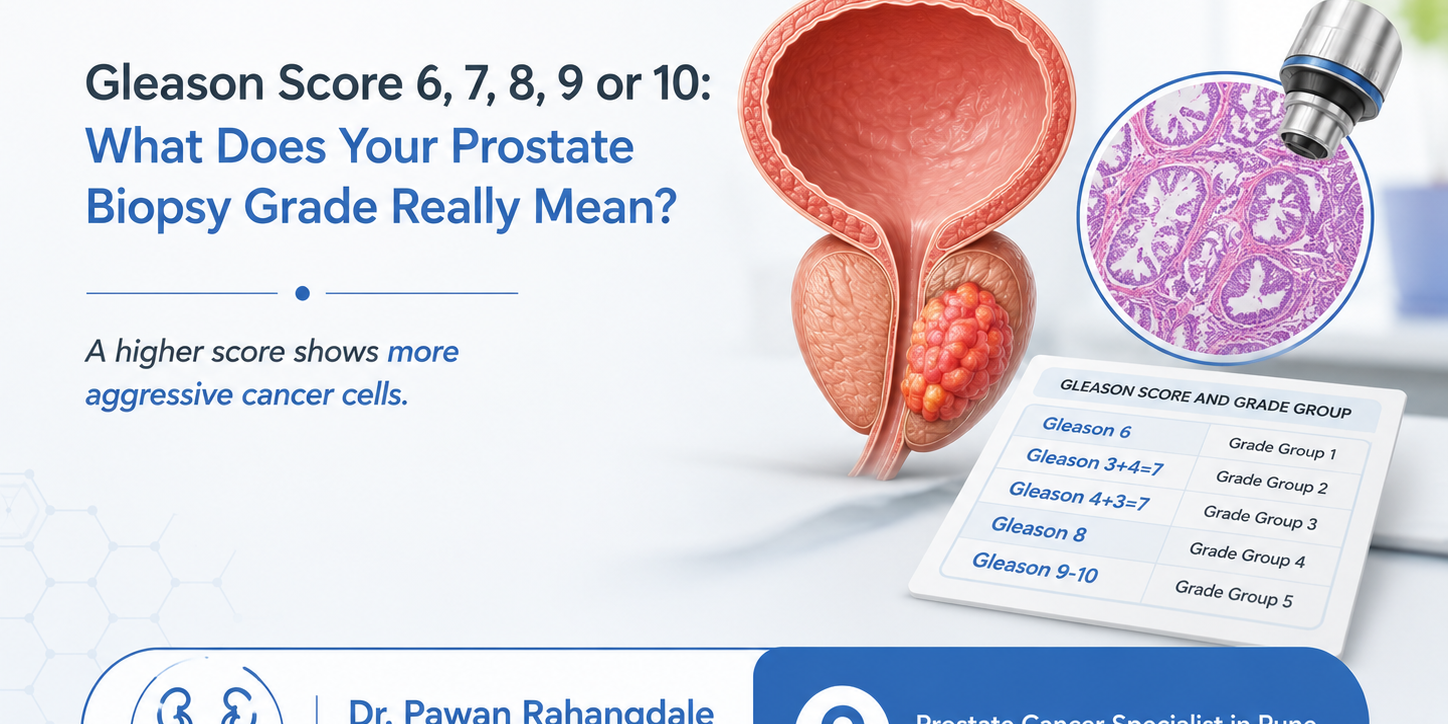
Explanation From a Prostate Cancer Specialist in Pune
A prostate biopsy report includes several medical terms, but the Gleason score is one of the most important. It describes how abnormal the cancer cells look and provides information about how the cancer may behave.
A higher Gleason score generally indicates a greater likelihood of faster growth or spread. However, the score does not independently show the cancer’s stage, whether it has spread or which treatment is best.
Dr. Pawan Rahangdale explains that Gleason score, Grade Group, PSA, MRI findings, clinical stage, biopsy volume and the patient’s general health must be considered together.
How Is the Gleason Score Calculated?
A pathologist examines prostate tissue under a microscope and identifies the two most relevant growth patterns. Each pattern is assigned a grade, usually 3, 4 or 5 in contemporary prostate cancer reporting.
The first number represents the predominant pattern. The second represents the next most significant pattern. The two numbers are added to create the Gleason score.
For example:
- Gleason 3+3 equals 6
- Gleason 3+4 equals 7
- Gleason 4+3 equals 7
- Gleason 4+4 equals 8
Although 3+4 and 4+3 both total 7, they are not equivalent. A 4+3 tumour contains more aggressive pattern 4 and generally carries greater risk than a 3+4 tumour.
What Are Prostate Cancer Grade Groups?
The Grade Group system makes Gleason results easier to understand:
- Grade Group 1: Gleason score 6
- Grade Group 2: Gleason score 3+4=7
- Grade Group 3: Gleason score 4+3=7
- Grade Group 4: Gleason score 8
- Grade Group 5: Gleason score 9 or 10
The National Cancer Institute describes Gleason 6 as low-grade, Gleason 7 as intermediate-grade and Gleason 8 to 10 as high-grade cancer.
What Does Gleason Score 6 Mean?
Gleason 6, or Grade Group 1, is the lowest score commonly assigned to prostate cancer on a modern biopsy. It generally indicates cells that are less aggressive in appearance.
Some men with localized, low-volume Gleason 6 disease may be suitable for active surveillance rather than immediate surgery or radiation. Surveillance may include PSA testing, examinations, MRI and repeat biopsy when indicated.
Gleason 6 still requires proper risk assessment. PSA density, the number of positive cores, cancer length within each core and MRI findings can influence whether surveillance is appropriate.
What Does Gleason Score 7 Mean?
Gleason 7 is divided into two clinically important groups.
Gleason 3+4=7, Grade Group 2: Most of the tumour consists of pattern 3, with a smaller amount of pattern 4. Selected patients with favourable features may sometimes be considered for active surveillance, while others need definitive treatment.
Gleason 4+3=7, Grade Group 3: Pattern 4 is predominant. This generally carries a higher risk of recurrence and spread than 3+4 disease and is more likely to require active treatment.
The pathology report may also mention cribriform or intraductal features. These can influence risk assessment and management even when the total score is the same.
What Do Gleason Scores 8, 9 and 10 Mean?
Gleason 8 corresponds to Grade Group 4. Gleason 9 and 10 correspond to Grade Group 5. These are high-grade cancers with a greater likelihood of growing or spreading.
Higher-grade cancer does not automatically mean the disease is incurable. Some high-grade cancers are still confined to the prostate or nearby area and may be treated with curative intent.
Further staging may involve prostate MRI, CT, bone imaging or PSMA PET, depending on PSA, grade and clinical findings. Treatment may include surgery, radiation, hormone therapy or a combination.
Is Gleason Score the Same as Cancer Stage?
No. Grade and stage describe different aspects of cancer.
The Gleason score describes microscopic appearance and biological aggressiveness. Stage describes where the cancer is located and whether it has spread beyond the prostate.
A patient can have a high-grade cancer that remains localized or a lower-grade cancer with a larger local extent. Treatment decisions require both pieces of information.
What Else in the Biopsy Report Matters?
A prostate cancer specialist also reviews:
- Number of biopsy samples containing cancer
- Percentage or length of cancer in each sample
- Whether cancer is present on one or both sides
- Presence of perineural invasion
- Cribriform or intraductal patterns
- Results from targeted and systematic samples
- Correlation with the suspicious MRI lesion
Biopsy findings may occasionally be upgraded or downgraded after prostate surgery because the complete prostate provides more tissue for examination than needle samples.
How Does the Score Affect Treatment?
Low-risk localized cancer may be monitored through active surveillance. Intermediate-risk disease may require surgery or radiation depending on whether features are favourable or unfavourable. High-risk disease frequently needs more intensive treatment or combined therapies.
Age, other medical conditions, urinary function and personal priorities also matter. Treatment should not be selected solely because another patient had the same numerical score.
Consult Dr. Pawan Rahangdale at Urovision Urology Care Clinic
At Urovision Urology Care Clinic, Dr. Pawan Rahangdale reviews biopsy grade, PSA, MRI and staging findings before discussing treatment options.
Patients consulting a prostate cancer specialist in Pune can receive an individualized explanation of their Gleason score and whether active surveillance, surgery, radiation or additional staging is appropriate.
Frequently Asked Questions
1. Is Gleason 6 cancer dangerous?
Gleason 6 is usually low-risk and may grow slowly, but its significance depends on PSA, tumour volume, MRI and stage. It requires structured monitoring even when immediate treatment is not recommended.
2. Why is Gleason 4+3 worse than 3+4?
The first number represents the predominant pattern. Gleason 4+3 contains more pattern 4, which is associated with more aggressive behaviour than pattern 3.
3. Can a Gleason score change?
The reported grade may change after repeat biopsy or prostate surgery because more tissue becomes available for examination. Cancer biology may also evolve during long-term surveillance.